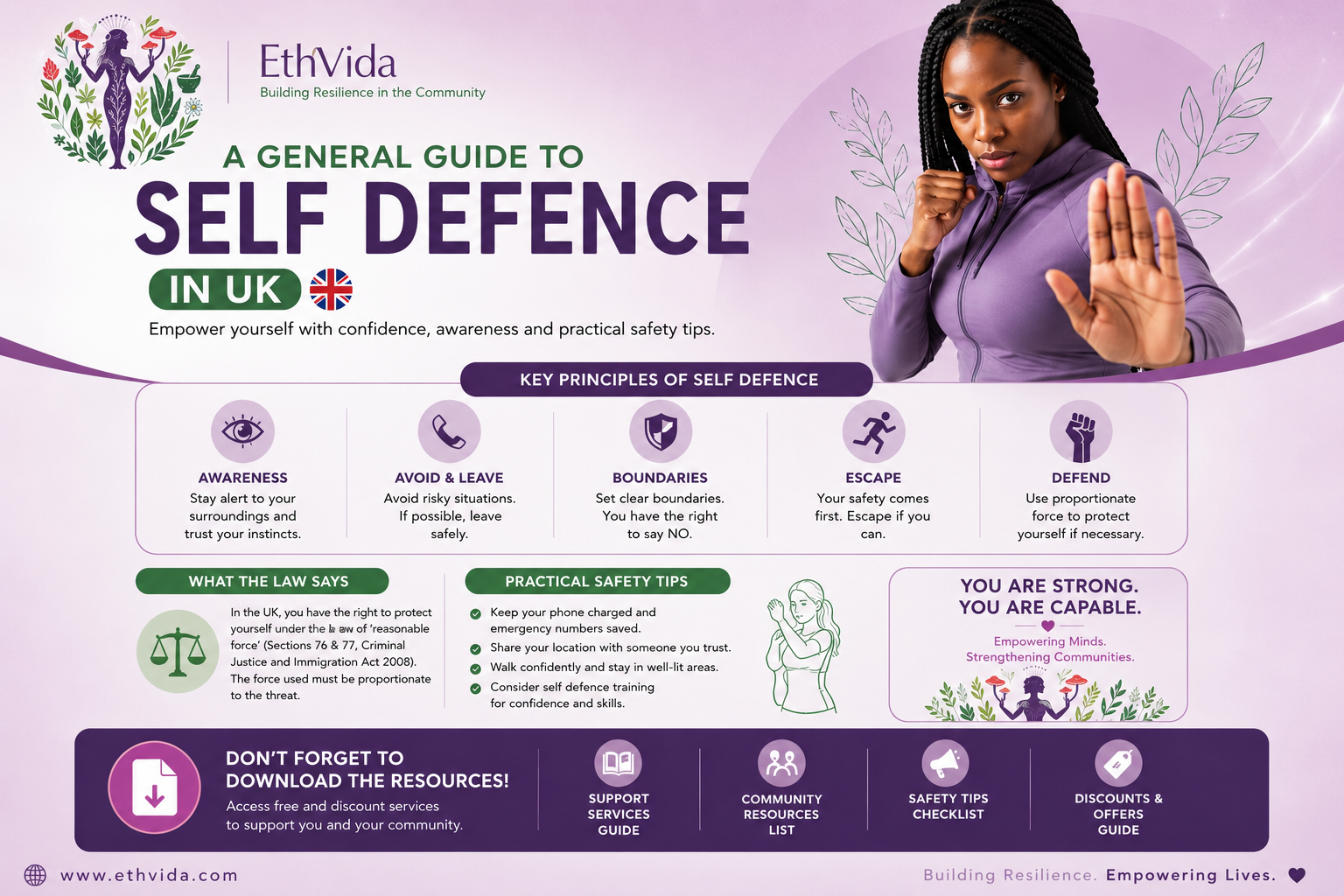
Self Defence
Every woman has the right to feel safe, respected and protected, whether at home, at work, travelling, studying or enjoying social activities. While responsibility for violence always lies with the perpetrator, personal safety awareness and self-defence education can help women recognise risks, build confidence and respond effectively in threatening situations.
Self-defence is not simply about fighting back. Modern self-defence focuses on prevention, awareness, confidence, communication and escape. The objective is always to avoid danger wherever possible and to reach safety as quickly as possible if a threat arises.
This guide outlines practical self-defence strategies, legal personal safety tools, training opportunities and support services available throughout the United Kingdom.
Every woman has the right to feel safe, respected and protected, whether at home, at work, travelling, studying or enjoying social activities. While responsibility for violence always lies with the perpetrator, personal safety awareness and self-defence education can help women recognise risks, build confidence and respond effectively in threatening situations.
Self-defence is not simply about fighting back. Modern self-defence focuses on prevention, awareness, confidence, communication and escape. The objective is always to avoid danger wherever possible and to reach safety as quickly as possible if a threat arises.
This guide outlines practical self-defence strategies, legal personal safety tools, training opportunities and support services available throughout the United Kingdom.
Understanding Self-Defence
Self-defence is a combination of mental preparedness, situational awareness and physical skills.
Effective self-defence includes:
✅ Recognising potentially dangerous situations early
✅ Trusting your instincts when something feels wrong
✅ Setting clear personal boundaries
✅ Using confident verbal communication
✅ Avoiding unnecessary confrontation
✅ Escaping from dangerous situations safely
✅ Learning practical physical self-defence techniques
✅ Understanding how to seek help and report incidents
Research consistently shows that awareness and prevention are the most effective forms of personal protection. Physical techniques should always be considered a last resort when escape is not immediately possible.
Situational Awareness
Situational awareness means paying attention to your surroundings and recognising unusual behaviour before it escalates into a threat.
Women are encouraged to:
✅ Remain aware of people and activity around them
✅ Avoid becoming distracted by mobile phones in isolated areas
✅ Take note of available exits and safe locations
✅ Be cautious if someone appears to be following them
✅ Trust their instincts and leave situations that feel unsafe
✅ Seek assistance immediately if concerned about their safety
Personal safety experts frequently emphasise that intuition is an important protective tool and should never be ignored.
Essential Personal Safety Tools Women Can Legally Carry in the UK
1. Personal Safety Alarm (Rape Alarm)
A personal safety alarm is one of the most effective legal safety devices available in the United Kingdom.
When activated, the alarm emits a loud siren designed to attract attention and deter an attacker.
Benefits include:
✅ Fully legal throughout the UK
✅ Small, lightweight and affordable
✅ Can attract immediate assistance from members of the public
✅ Suitable for students, commuters, runners and shift workers
✅ Easy to attach to keys, bags or clothing
Many police services and community safety organisations recommend personal alarms as a simple but effective safety measure.
2. Safety Whistle
A whistle remains one of the simplest and most reliable emergency tools available.
Advantages include:
✅ No batteries required
✅ Lightweight and inexpensive
✅ Can be heard over considerable distances
✅ Useful when a mobile phone cannot be accessed
✅ Effective in both urban and rural environments
3. Mobile Phone Emergency Features
Modern smartphones include emergency functions that can rapidly contact emergency services and trusted contacts.
Women should consider:
✅ Enabling Emergency SOS features
✅ Saving emergency contact information
✅ Activating location-sharing functions with trusted family members or friends
✅ Learning how emergency calling works on their device
✅ Keeping mobile phones adequately charged when travelling
4. Personal Torch
A compact torch can improve visibility and awareness during hours of darkness.
Benefits include:
✅ Illuminating poorly lit areas
✅ Improving visibility while walking
✅ Identifying potential hazards
✅ Assisting in emergency situations
Rechargeable LED torches are widely available and easy to carry.
5. Safety and Journey Tracking Applications
Several safety applications provide additional reassurance when travelling alone.
Common features include:
✅ Live location sharing
✅ Journey tracking
✅ Emergency alerts
✅ Check-in notifications
✅ Direct contact with trusted individuals
Important Legal Guidance
Women should be aware that some products marketed online as self-defence equipment may be illegal to possess in the United Kingdom.
The following items should not be carried:
❌ Pepper spray
❌ CS gas
❌ Mace
❌ Stun guns
❌ Knuckledusters
❌ Offensive weapons disguised as everyday items
❌ Certain self-defence keyrings marketed as weapons
Possession of prohibited weapons may result in criminal prosecution.
Legal alternatives include:
✅ Personal safety alarms
✅ Safety whistles
✅ Mobile phone emergency features
✅ Personal safety training
✅ Community self-defence courses
Personal Safety When Travelling
Whether travelling locally or nationally, preparation can significantly improve personal safety.
Women are encouraged to:
✅ Plan journeys in advance
✅ Inform trusted individuals of travel plans
✅ Use licensed taxis and reputable transport providers
✅ Remain in well-lit and populated areas where possible
✅ Sit near other passengers when travelling on public transport
✅ Avoid isolated locations late at night
✅ Keep emergency contact information accessible
Personal Safety in Social Settings
Social events should be enjoyable and safe.
Practical precautions include:
✅ Monitoring drinks at all times
✅ Avoiding accepting drinks from strangers
✅ Travelling with trusted friends where possible
✅ Arranging transport home before going out
✅ Looking after friends and encouraging group safety
✅ Leaving immediately if a situation feels unsafe
Online and Digital Safety
Personal safety extends beyond physical environments.
Women should consider:
✅ Using strong and unique passwords
✅ Enabling two-factor authentication
✅ Reviewing privacy settings regularly
✅ Limiting the sharing of live location information
✅ Reporting online harassment and stalking
✅ Blocking individuals who engage in threatening behaviour
Digital safety is increasingly recognised as an essential part of modern self-defence.
Why Self-Defence Training Matters
Self-defence training provides more than physical skills.
Benefits often include:
✅ Increased confidence
✅ Improved personal awareness
✅ Enhanced decision-making under pressure
✅ Better understanding of personal boundaries
✅ Reduced fear and anxiety when travelling alone
✅ Greater physical fitness and wellbeing
✅ Stronger community connections
Many women report that the confidence gained through training positively impacts other areas of life, including education, employment and personal relationships.
Free Women’s Self-Defence Classes in the UK
A number of organisations, councils and community groups provide free or subsidised self-defence training.
Current examples include:
✅ Women’s Self Defence UK community workshops
✅ Southwark Council women’s self-defence sessions
✅ Westminster women’s self-defence programmes
✅ Japanese Jiu Jitsu UK free women’s classes
✅ Phoenix Community Housing self-defence courses
✅ Community safety programmes delivered by local authorities
Support Services
Women experiencing harassment, abuse or violence should seek support immediately.
Important services include:
✅ Emergency Services – Call 999 in an emergency
✅ National Domestic Abuse Helpline – 0808 2000 247
✅ Women’s Aid
✅ Victim Support
✅ Local Police Services
✅ University and workplace safeguarding teams
Support is available regardless of age, background, ethnicity, faith, disability or immigration status.
For a Comprehensive List – Download Here!
Conclusion
Women have the right to live free from violence, intimidation and fear. While society must continue to challenge and prevent violence against women and girls, personal safety education remains an important tool for empowerment and protection.
By combining awareness, confidence, practical training and legal safety equipment, women can strengthen their ability to recognise risks, respond effectively and seek help when required.
Self-defence is not about living in fear. It is about living with confidence, independence and the knowledge that you have the skills and resources to protect yourself when necessary.


