
What is Mindfulness?
As suggested in its name, mindfulness at its core, is all about self-awareness!
Mindfulness is a technique used to help us learn how to be present in the moment, and not get pulled away by your thoughts or life circumstances. This enables you to live in the moment and be aware of how you’re feeling, your thoughts processes and more insight into your mental health.
Why is being in the present important?
Being in the present, encourages you to not just be aware of your thoughts and your feelings. It also allows you to appreciate yourself and what you have, as well as enabling you to understand what various factors you need to work on and plan accordingly.
Always remember, focusing too much on the past, fuels depression, and focusing too much on the future, fuels anxiety. Therefore, the best place you can be in, is the present, only there can you heal the wounds of the past, and plan for a better future, whilst being present and enjoying every moment in life!
There are various benefits of Mindfulness, these include: –
- Plan for future
- Awareness of how you are feeling emotionally
- Awareness of how you are feeling physically
- Feel Calmer
- Awareness of your thoughts
- Boosts attention/concentration
- Building Resilience
- Improve your relationships, as you’re not as full and have more capacity to be reciprocal
- Managing negative thoughts and emotions
Who is mindfulness for?
Anyone can practice mindfulness, however it is advised with people who have PTSD, to proceed with caution, as being present with traumatic emotions, could aggravate your symptoms. We advise you to speak to your GP for further guidance on how you can practice mindfulness safely.
For more information and further self-guided resources, check out this article from the mental health foundation: https://www.mentalhealth.org.uk/explore-mental-health/a-z-topics/mindfulness
(Note – please use this guide to incorporate mindfulness into your goal planning objectives)
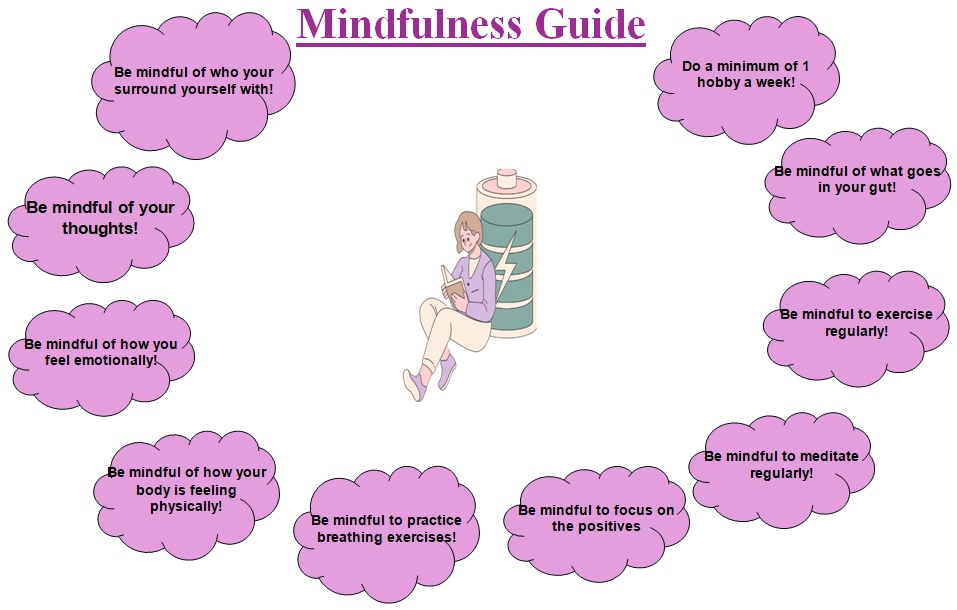
| Mindfulness Guide | ||
|---|---|---|
| 1. | Hobbies / Activities |
Always remember, when engaging in a hobby, you release lots of healthy hormones. |
| 2. | Gut Health |
Always remember, you are what you eat, therefore what you put in your body, is possibly one of the most important things, often prioritised over exercise, due to its contribution to the regulation of the body; its 70% diet and 30% exercise (an apple a day, keeps the doctor away). |
| 3. | Exercise Regime |
Always remember, it’s healthy to push yourself, but don’t overdo it, remember to speak to your GP or healthcare provider, if you are someone who struggles with a chronic illness, that either impacts their mobility or would worsen with strenuous exercise. |
| 4. | Guided Meditation |
Always remember, meditation doesn’t need to be thirty minutes to an hour, it can just be 5 minutes at the start or end of your day. For a beginner, guided meditation guide, check out this YouTube video: https://youtu.be/xv-ejEOogaA?feature=shared |
| 5. | Positive Outlook |
Always remember, even when you’ve had a bad day, week, month or year, and it’s hard to find something positive, a lesson learnt is positive viewpoint. |
| 6. | Breathing Exercises |
Always remember, breathing exercises can be done at any point during the day, particularly if you find yourself feeling overwhelmed during the day, all you need is to dedicate 3-5 minutes. For beginners breathing guide, please check out this YouTube guide: breathing exercises – YouTube |
| 7. | Physical Sensations |
Always remember, certain mental health conditions can manifest in the body, with anxiety for example, displaying characteristics, such as: sweating, heart palpitations, chest pain, shortness of breath, numbness or tingling sensation, muscles tension, upset stomach, headaches and insomnia. |
| 8. | Emotional Sensations |
Always remember, every emotion is healthy, happiness, sadness, anger, jealousy, excitement etc, and we need to embrace them, they are all a part of who we are, it does not make you a bad person or a good person, it makes you human, we have both in us, and the one that wins, is the one you feed! |
| 9. | Thoughts / Thinking process |
Always remember, when you have an intrusive thought, you need to find evidence in your life of you having overcome that experience, and remind your brain, that you’ve done this before and you can do it again! |
| 10. | Social Circle |
|
| 11. | Takeaway | Changing your routine can be difficult, and this is why it is important to gradually introduce changes. The first place to start, is to pick a day in the week that is a You day, and on that day, you do nothing, absolutely nothing! You might feel guilty at first and think, you’re wasting time, but you are not, think of it more as gathering strength or recharging, you can’t pour from an empty cup.We also always advise having a morning and evening routine, as this makes a big difference to helping you feel more grounded, as your mind knows what to expect. This is particularly good for people who struggle with anxiety, depression or any other mood disorder.(Note – please use this guide to incorporate mindfulness into your goal planning objectives) |


19 January 2026, 12:35 am
Thank you for your sharing. I am worried that I lack creative ideas. It is your article that makes me full of hope. Thank you. But, I have a question, can you help me? https://www.binance.info/ar/register?ref=FIHEGIZ8
29 January 2026, 8:24 pm
Thank you for your sharing. I am worried that I lack creative ideas. It is your article that makes me full of hope. Thank you. But, I have a question, can you help me? https://accounts.binance.com/fr/register?ref=T7KCZASX