Change Theory

Change Theory

Change Theory

When thinking about making changes in life, there is one thing that you must consider, and that is ‘Rome wasn’t built in a day’, so expect setbacks, relapse and lots of frustration. This is normal, as when people finally take the plunge to make changes, they want to see results immediately, but unfortunately that will not happen, and it’s important that you are mentally prepared for this, as this enables you to shoulder through the more challenging periods.
change theory steps image

What is change?

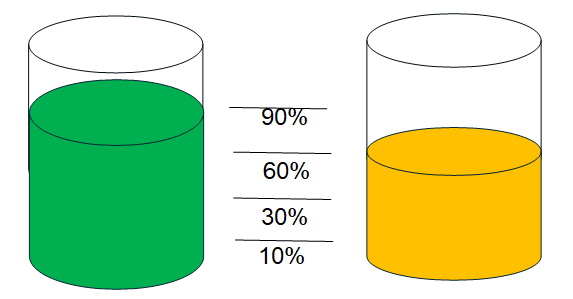
Change is generally described as making someone or something different, via an act or a process. In order for you to be proactive about making changes in your life, your motivation must outweigh your desire, otherwise, no change will take place.

Generally, people get frustrated with themselves when they want to make changes and are struggling to implement them.This is generally because you might want something, but if you aren’t motivated enough, nothing will change, as motivation is the driving factor for action!

What is desire?

Desire is described as a strong feeling of wanting to have something or wishing for something to happen!

What is motivation?

Motivation is described as an internal state of mind, that pushes people to be proactive about attaining their goals.

Motivation

Desire
Motivation Desire img

Don’t forget, even with motivation at its peak, change is a process or often described as a cycle one navigates their way through, it’s not a simple step.

How to build motivation?

Motivation is difficult to sustain and for most people, you’re not generally motivated until you start to see changes. Therefore, a technique to help motivate you is to write down small goals that are achievable, and work towards your bigger goals, this will support you to get a sense of gratification of moving forward and builds momentum. Remember to reward yourself for every achievement, you deserve it, and it also stimulates the reward centre of the brain, releasing healthy chemicals to the bloodstream.

As previously stated, without motivation to change, no change will take place, desire creates preparation, but motivation creates action and change!

For more information on building motivation, check out Psychology Today’s publication: How to Increase Self-Motivation | Psychology Today.

Pros and Cons of change?

Pros Cons
  • Old behaviour is altered to support a healthier lifestyle
  • You learn new things about yourself
  • It helps you build on resilience
  • Teaches you discipline
  • Teaches you to sit with your emotions / manage your emotions
  • Fear of change
  • Fear of the future
  • Old behaviour continues and these can continue to have a detrimental affect to your current life
    and wellbeing
  • No resilience is being built
  • You stay stuck at that point of your life, unable to progress further

The Cycle of Change?

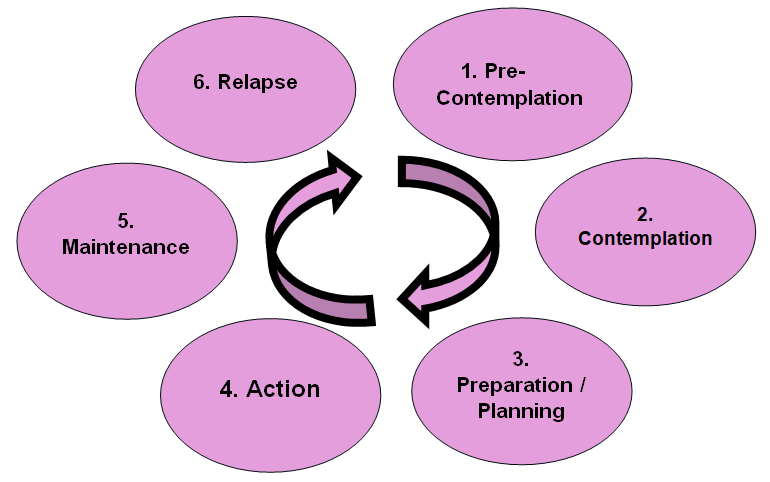
The cycle of change, also known as change theory (Prochaska & DiClemente 1983), commonly used in substance misuse services to support patients to change negative behaviour and patterns. Change theory is a process, categorised by stages that one goes through when modifying one’s behaviour. The process has no end, as it signifies a never-ending cycle; this means, it is a continuous process that requires regular implementation, as old habits die hard! To really make sustaining changes to your lifestyle you need to understand that mistakes and setbacks are crucial to the change process. A person in the process of change may go around the cycle repeatedly before eventually managing a new stable lifestyle/change with the looming risk of relapse.

Stages Comments
Pre-Contemplation
  • This is the point in which the individual isn’t aware that a problem exists and therefore have no desire to change their behaviour
  • People often tend to dismiss the topic/situation at hand when mentioned and cannot see any fault with their behaviour
  • Usually at this point, the person is experiencing negative consequences which are apparent to others, however the individual unable to recognise this
  • This is the denial stage of cycle, and people can stay here for a long time, impacting their growth as you are fixated and unable to move forward
Contemplation
  • At this point the individual is aware a problem exists, but has little to no desire to take any action towards making any changes
  • This is the point where one’s desire is now being formulated but is somehow being hindered by either self-confidence, fear of change, fear of success
  • At this stage, you are not yet motivated to change. Although motivation is the driving factor to change, motivation is formulated by desire
  • Although you are aware that there are behaviours you require changing, in order for you to move forward. Nonetheless forward scares you and therefore motivation for change is limited
Planning / Preparations
  • This is the stage, where the individual is planning and has the intention of taking action to address their problem
  • At this point they are planning, and working out how to solve their ‘problem’, and they spend a lot of time thinking and preparing for change
  • People often confuse this stage with action, as the person is for example booking appointments,talking about the steps they will be taking but are not necessarily making the change
  • However, at this stage you are also now thinking more positively about the future as you are recognising the consequences to your behaviour / actions
Action
  • At this stage the individual would start taking the necessary steps and are actively changing their behaviour
  • Longest part of process in the cycle as this requires repetition, consistency and determination and one can become easily demotivated and slip back into old patterns however, maintaining a routine will support in modification of behaviour
  • It is always important to try new things, sometimes some things we believe may be able to support us however in practice you struggle to use this technique, try other techniques until you identify a style that works for you
Maintenance
  • This is the stage in which you would need to sustain the change, by ensuring that you reinforce the new habits and replacing old behaviours
  • Once you have identified techniques that work for you, consistency supports with replacing the old habits with new habits
  • Change is a long process and can take 12 weeks for your behaviours to become second nature to you, therefore the first 12 weeks it is very important to have consistency to ensure these changes are embedded
Relapse
  • This is the stage where people can fall back into old patterns, and this is a part of the process of change
  • People tend to be upset when they get to this point, as if they have failed, but with change sometimes it’s about finding what works for you and what didn’t therefore you can change the things that did not work for you and restart the change process
  • Each time the person goes through the cycle they learn from each relapse, and this helps for you to stay in this stage shorter and less devastating for yourself
  • With the cycle, it is an ongoing process and you can go forward and backwards until the change is successful
2 Comments
Write a comment