
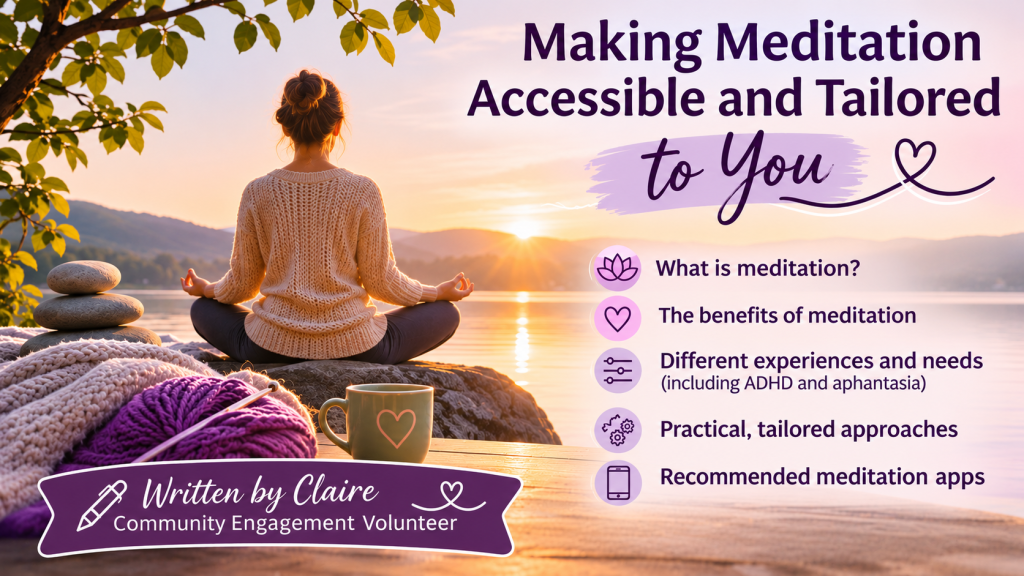
Author: Claire
What is Meditation?
Meditation is a gentle practice that encourages you to focus your attention, become more aware of the present moment and develop a calmer relationship with your thoughts and feelings. There is no single right way to meditate. You might enjoy guided meditation, calming music, breathing exercises, body scans or simply sitting quietly and observing your surroundings. Meditation is not about emptying your mind or achieving perfect stillness. It’s about finding an approach that works for you, at your own pace, in a way that feels comfortable and accessible.
It’s important thing to remember is that we don’t all experience meditation in the same way. Some people have aphantasia, meaning they have little or no ability to create mental images, often described as having no mind’s eye. For example, they may know exactly what a beach looks like but cannot actually picture it in their imagination. This can make visualisation-based meditation difficult, which is why it’s important to explore different techniques and find an approach that works for you.
The Benefits of Meditation
Regular meditation may offer a range of benefits for your physical and emotional wellbeing, including:
- Reduced stress and anxiety – Helping you feel calmer and better equipped to manage everyday pressures.
- Improved emotional wellbeing – Encouraging self-awareness, patience and kindness towards yourself.
- Better sleep – Supporting relaxation and helping you establish a peaceful bedtime routine.
- Improved concentration – Helping you practise bringing your attention back when your mind wanders.
- Chronic pain management – Potentially helping some people change how they experience and respond to persistent pain.
- Greater body awareness – Encouraging you to recognise tension, discomfort and your body’s changing needs.
- Improved relaxation – Creating opportunities to slow down, unwind and reconnect with yourself.
Remember, meditation is a personal journey. Even a few gentle minutes can be a meaningful starting point, and you can adapt your practice to suit your health, mobility and individual needs.
What is Meditation for Me?
What is meditation? when I first started, I had a very set view on what it entailed. Sitting in a silent room, tuned into the universe immune to distractions, the ultimate zen, effortless and calm the doctors made it sound so easy, so did the. Internet needless to say. I failed spectacularly miserably in fact looking back? that’s a funny thing to say because you can’t actually do this wrong but at the time it felt like I was getting it wrong. Nothing came naturally nothing worked how I expected, and I felt utterly miserable not one single second of my experience was zen, nothing felt right.
Adding insult to injury I felt frustration, hopelessness and inadequacy. This led to meltdowns and tears followed, instead of peace, I found anxiety. Meditation became my own insurmountable mountain, while everyone else appeared to have no mountain at all.
If your friend tells you how amazing it was, so it was so effortlessly, and LED to instant peace , don’t feel too demoralized everyone takes their own time with this journey for some its easy straight away and that’s fine but if you don’t that’s also fine I can understand how frustrating it is. But you haven’t done anything wrong and there’s nothing wrong with you. It just takes some people longer to settle in for it to come a bit more naturally that’s completely OK be gentle with yourself and let go of comparing your journey to anyone else’s and go at a pace that feels right for you.
Everyone’s Experience is Different
I want to mention two things that I struggle with which might be relevant for some of you, I have ADHD which made mediation that much harder to focus properly. I often have to fiddle, this is usually against everything they advise when meditating. However, this is a great example of tailoring meditation to fit you in a real-life application. For me crocheting is wonderful It’s rhythmic there’s a gentle kind of counting to it and my hands are happily occupied so that I can clear my mind more easily and actually focus on the meditation itself it can also be meditative all on its own too. Other suggestions would be to find something you enjoy touching and fidgeting with something with a nice texture like a smooth stone or a shell, Something quiet works best. Even a fidget spinner or simply stroking your pet whilst you lie or sit quietly together music can also be a great tool.
I also have no mind’s eye, zilch otherwise known as aphantasia so that whole visualisation of me on a beach or descending stairs during guided mediation was a useless task and as useful as a chocolate teapot. I was also unaware that everyone had varying degrees of a mind’s eye, for some a perfect 3D image for others slightly vague all the way to pitch black like me, so bear this in mind as you practise meditation as to what approach might work best, and finding out what works for you.
Instead of worrying how it should be let’s look at this another way, we want meditation to work for us, to fit into our lives and routines, in a way that eventually feels natural, rather than force ourselves into a situation we’ve tried over and over again. Practise is important and does help it become more automatic, but it is also important to adapt something so that it works for you, if it’s not working explore other options that idea is at the very heart of holistic health. There are so many ways to get into that meditative zone, and I am going to give you a few suggestions that might work for you, what I strongly recommend is starting whatever meditation you decide to try, with something called diaphragmatic breathing.
Diaphragmatic breathing a great start to your meditation
Diaphragmatic breathing helps you breathe in a way that relaxes your nervous system and regulates you, the goal of diaphragmatic breathing is letting your diaphragm drop down gently as you breathe in the diaphragm will naturally drop all on its own do not force it, this pulls, a deep, full breath into your lungs your belly expands outwards and your ribs widen both sideways and outwards all opening up to make space more air to enter.
Rather than breathing shallowly into your chest, you can hold it for a couple of seconds if you like before letting it go in a smooth, controlled breath as you breathe out, the diaphragm relaxes and your belly falls gently in, if you do this continuously, before whatever meditation you’re about to do, it will also help you get in the mindset that that is what you will be doing and you will relax quicker. You can also use it day to day to help calm down no matter where you are it’s even more beneficial if you do something called breath awareness which is simply resting your attention on a physical feeling of your breath, whether you find that easier to focus it going into your nose to your lungs, expanding or your belly moving up and down, it fits naturally alongside every other meditative practise. It supports, deepens and compliments, but can be a meditative practise all on its own and it can act as an anchor whenever your mind wanders which is inevitable. The key It’s to observe that it has happened without judgement and to pull your focus back into the meditation.
Benefits you may notice with regular practice:
- When’s meditation becomes a steady habit you may find
- Calmer mood
- Less stress
- Better stress management
- Stronger connection to body and mind
- Greater awareness of what your body needs
- Better pin management
- Feeling more grounded and present
- Greater kindness towards yourself
Here are some other meditation types to try that are great for beginners
Guided Video Overview
Explained by A former registered nurse from Australia who specialised in pelvic floor respiratory and gentle breathing physiotherapy education for over fifteen years.
- https://www.youtube.com/watch?v=9jpchJcKivk (Video 3:52 minuets)
Body scan
Get into a comfortable position either sitting or lying in a calm and quiet environment you’re going to focus on your body and how it feels. Start with your toes. Notice how they feel and if you hold any tension there, gently tense your muscles and then relax them You will do this going up your body in a methodical manner observing how each body part feels tensing it gently and then consciously relaxing go all the way up to your head. This is great for releasing any tension and connecting with your body and identifying where there’s pain or any kind of issue. Try this for five to 10 minutes a day.
Guided video by Professor Mark Williams a professor of clinical psychology
- https://www.youtube.com/watch?v=CyKhfUdOEgs (Video 14:47 minuets)
Loving kindness
Loving kindness meditation is all about shifting your perspective. This may be especially helpful if you’re struggling emotionally or with your mental health Although be careful not to put pressure on any outcome that will stress you out Which it’s obviously not the intent with meditation With that in mind this is how it works So naturally our brains are wired to support trouble first What’s going wrong What you don’t have in life. What feels hard or unfair What you feel are your shortcomings potentially but loving kindness meditations aim is to gently turn your perspective the other way instead of only seeing what’s missing you start intentionally looking towards what’s good what’s possible what you wish to grow for yourself and others It may help you feel more positive towards goals you want if you practise this consistently.
The hope is you start rewiring your brain to make it easier to see the positives in your life. To help you feel more in control of achieving goals and see yourself in a more positive light It’s not about pretending hard things don’t exist or unfair things don’t happen It’s about making room for goodness and positivity alongside it this may be especially difficult at first especially if you’re struggling with mental health or a difficulty in your life. The key to this is to do short bouts everyday. You can build them up if you wish but start small 5 to 10 minutes it’s perfect It helps it feel less overwhelming if you give it a short amount of time I recommend doing this at the beginning of the day but whatever works in your routine. Even if you struggle, try and commit yourself to those five to 10 minutes, and as you continue it will get easier and become second nature.
Guided video by Sharon Salzberg a founding teacher of loving kindness in the West with 40 plus years experience
- https://www.youtube.com/watch?v=e-TeW9CI0bc&t=244s (Video 8:09 minuets)
Box breathing
Box breathing is centred around creating a steady calming rhythm with your breath It is very simple You will breathe Hold your breath in count 1234. Then breathe out counting 1234 and repeat Focus on the feel of the breath in your lungs Try and fill your lungs at the bottom. Breathing sideways Focus on your ribs going sideways rather than out breathing slowly and thoughtfully It is great for a quick anxiety reduction, It is also great for quickly resetting when you feel overwhelmed angry or stressed try it for 2 to 5 minutes. The key is to go slowly and intentionally ideally it’s somewhere peaceful it can also help if you just move away from the area that you have been stressed by. But if that is impossible… It will still work It just might take a bit more focus I find it helps to close my eyes or stare at an object I prefer a candle but anything will do.
Guided video by a qualified mindfulness teacher Slow gentle beginner friendly pace
- https://www.youtube.com/watch?v=oN8xV3Kb5-Q ( (video 6:52 minuets)
A few kind reminders
- You cannot do it wrong
- A wondering mind isn’t failing gently bringing it back is the practise
- Short and often is the key especially when you’re starting out 5 minutes every day helps more than 1 hour in a while
- When Starting out it helps to practise when you’re already feeling reasonably calm and relaxed. This gives you the easiest kindest start You get to feel what it’s like without the extra struggle every time you do this you’re building new and positive habits deep inside your mind calm or become more familiar or natural or like a second nature or state of mind.
- The more you practise the easier it is to find that quiet space
- Even when life is hard as it becomes a familiar habit you’ll find it gets easier to settle into that gentle focus even when you’re stressed upset or angry Your mind will already know the way This is also known as creating new neural pathways
- The best part it’s even if you’re feeling really anxious or completely unsettled it’s always worth trying, might not feel as smooth at first. But it can still help stead you little by little I recommend doing the box breathing as I feel this is the easiest when you’re agitated
A gentle extra: Positive affirmations
You might also like to try pairing meditation with positive affirmations they work beautifully together where meditation quiets and studies your mind and ground you affirmations add kind encouraging words to that quiet space. They plant good thoughts right where they can take root think of it like this meditation makes a calm space in your mind affirmations are planting gentle hopeful seeds in that space you can get spoken affirmations. Alternatively, you can make your own together they can help calm you and lift you up a wonderful combination to try when it feels right for you It is especially good for mood boosting and for confidence.
APPs I Recommend for Meditation
Insight timer – Inside timer has the world’s largest premeditation library with thousands of independent teachers and styles to choose from making it easy to tailor your practise exactly to you. You can pick any length any voice any approach that feels right it also includes live sessions a custom timer and a gentle sense of shared practise and it’s mostly free.

Headspace – Headspace lets you tailor everything to you pick what you need right now, for example calm sleep focus or rest then you choose how much time you have and it gently guides you from there research backed guided mediations and popular sleep stories. There is a free taster available and then full access by subscription
Calm – Calm makes it easy to tailor your experience Just pick what you’re looking for whether that’s some guided meditations beautiful sleep stories gentle music or calming nature sounds. Pick what fits your mood and your time the app get to know what you like and suggests more of it There’s a limited free taster and full access by subscription.
Accessibility Hearing Support
Best App choices…
If you have hearing support needs here are things to bear in mind when choosing the right app for you:
- Headspace is the most accessible with captions on all English content vibration guides and visual breathing animations
- Calm is second best with a visual Breath bubble to guide you in your breathing and captions on most sessions
- Insight Timer is mostly audio transcripts are available on the website but app captions vary from session-to-session bear in mind these are just things to look out for
Please still try them for yourself and see what you connect with and what feels best for you Don’t be put off to give them a go, let’s take the stress out of meditation!
Trust your pace. This is your own individual journey- but you do not have to walk it alone
Explore Our Meditation & Mindfulness Playlists 💚
We’ve lovingly created and organised a collection of meditation playlists to make it easier for you to discover what works best for you.
Whether you prefer peaceful background music, supportive guided sessions or calming visualisation exercises, there are different approaches to explore. Our hope is that these resources offer a little comfort, encouragement and calm whenever you need them.
There is no perfect way to meditate — only the way that feels right for you. Explore our playlists, take your time and discover the practices that bring a little more peace and balance into your everyday life. 💚
- Meditation Music
Gentle, soothing music for quiet reflection, breathing exercises, independent meditation or simply taking a peaceful moment for yourself.
- Guided Meditation – Self-Help
Supportive guided meditations designed to encourage emotional wellbeing, self-compassion, relaxation and positive coping strategies.
- Guided Meditation – Visualisation
Calming guided sessions using imagery and imagination to encourage relaxation and mental focus. If visualisation doesn’t come naturally to you, that’s absolutely fine — you can explore our other meditation styles instead.
Article Links – Useful references for further reading
- Meditation a simple, fast way to reduce stress – https://www.mayoclinic.org/tests-procedures/meditation/in-depth/meditation/art-20045858
- Mediation, a promising approach to alleviating chronic pain – https://pmc.ncbi.nlm.nih.gov/articles/PMC10739252
- Meditation what you need to know – https://med.stanford.edu/content/dam/sm/pain/documents/meditation-facts.pdf
- Self-affirmation: understanding the effects – https://labs.psych.ucsb.edu/sherman/david/sites/labs.psych.ucsb.edu.sherman.david/files/pubs/sherman_2013.pdf
Disclaimer: Please note, all advice given is based on various healthcare models that have been proven to support patients with sustainability and backed by Public Health England (PHE). Nonetheless, you should run any changes to your routine by your GP as they are your primary healthcare provider and first point of contact. It is also important that any other healthcare professionals involved in your care is involved in any goal planning. Don’t forget they hold your medical records and are familiar with your health needs: this will help everyone be on the same page and will also enable you to plan more realistically and not overestimate your capacity, which could negatively affect your health.
References
1. Mayo Clinic — Meditation: A Simple, Fast Way to Reduce Stress
https://www.mayoclinic.org/tests-procedures/meditation/in-depth/meditation/art-20045858
2. Meditation: A Promising Approach to Alleviating Chronic Pain
https://pmc.ncbi.nlm.nih.gov/articles/PMC10739252/
3. Stanford Medicine — Meditation: What You Need to Know
https://med.stanford.edu/content/dam/sm/pain/documents/meditation-facts.pdf
4. Sherman et al. (2013) — Self-Affirmation: Understanding the Effects
https://labs.psych.ucsb.edu/sherman/david/sites/labs.psych.ucsb.edu.sherman.david/files/pubs/sherman_2013.pdf
5. NHS — Mindfulness
https://www.nhs.uk/mental-health/self-help/tips-and-support/mindfulness/
6. NHS — Breathing Exercises for Stress
https://www.nhs.uk/mental-health/self-help/guides-tools-and-activities/breathing-exercises-for-stress/
7. NICE — Depression in Adults: Treatment and Management (NG222)
https://www.nice.org.uk/guidance/ng222
8. Diaphragmatic Breathing — Guided Exercise
https://www.youtube.com/watch?v=9jpchJcKivk
9. Professor Mark Williams — Body Scan Meditation
https://www.youtube.com/watch?v=CyKhfUdOEgs
10. Sharon Salzberg — Loving-Kindness Meditation
https://www.youtube.com/watch?v=e-TeW9CI0bc&t=244s
11. Box Breathing — Guided Exercise
https://www.youtube.com/watch?v=oN8xV3Kb5-Q
12. Insight Timer — Meditation and Mindfulness
https://insighttimer.com/
13. Headspace — Meditation, Mindfulness and Sleep
https://www.headspace.com/
14. Calm — Meditation, Sleep and Relaxation
https://www.calm.com/