

Author: Berta Kaguako
Movement Is Medicine — But It Should Be Accessible to Everyone!!
When we think about yoga, we often picture people performing complicated stretches, balancing effortlessly or moving through challenging positions. But yoga is about much more than flexibility.
At its heart, yoga combines gentle movement, breathing, body awareness and mindfulness to support physical and emotional wellbeing. For people living with chronic illness, persistent pain, fatigue, reduced mobility or physical disabilities, traditional yoga classes may feel intimidating or inaccessible.
However, yoga does not have to involve standing, balancing or getting down onto the floor. It can be practised while sitting in a chair, lying comfortably on a supportive surface or moving gently through beginner-friendly positions.
As part of our holistic wellbeing approach, we believe that movement should be adapted to the individual — rather than expecting the individual to adapt to a particular exercise.
Why Movement Is Essential for Long-Term Health
Physical activity is one of the foundations of good health.
Regular, appropriate movement supports muscle strength, joint function, circulation, cardiovascular fitness and emotional wellbeing. According to the NHS, strength and flexibility exercises can help maintain bone density, improve balance and reduce joint pain [1].
The benefits extend beyond physical fitness….. Movement can also support confidence, independence and the ability to carry out everyday activities. For people living with chronic illness, maintaining some level of appropriate physical activity may help preserve function and reduce the effects of prolonged inactivity.
However, movement must be adapted to individual symptoms, energy levels and medical needs. People with post-exertional malaise, for example, may require specialist advice and an approach that avoids triggering symptom deterioration.
What Do UK Physical Activity Guidelines Recommend?
The UK Chief Medical Officers recommend that adults aim to incorporate physical activity into everyday life [2].
| Recommendation | UK Guidance |
| Moderate-intensity activity | Aim for at least 150 minutes weekly |
| Muscle-strengthening activity | At least 2 days each week |
| Movement throughout the day | Reduce prolonged inactivity where possible |
| For disabled adults | Adapt activity to individual abilities and health needs |
These are population-level recommendations, not requirements that everyone must achieve immediately.
For someone living with chronic illness, even a few minutes of appropriate movement may represent a meaningful achievement.
Importantly, gentle yoga may contribute towards flexibility, strength and balance, but it does not automatically count towards the recommended moderate-intensity aerobic activity target.
The goal is not to push through symptoms. It is to find safe, sustainable movement that supports your wellbeing.
How Yoga Supports the Body and Mind
1. Strength, Stability and Joint Support
Yoga involves controlled movements and positions that can challenge muscles in different ways. Over time, appropriately selected exercises may help improve muscular endurance, body awareness and stability. This is particularly relevant because muscles help support joints and contribute to everyday movements such as standing, reaching, walking and changing position.
Yoga should be adapted for people with joint instability or hypermobility, avoiding excessive stretching or forcing joints to their end range.
2. Flexibility and Functional Mobility
Maintaining comfortable movement through the joints can support everyday activities such as dressing, reaching and moving around the home. Gentle yoga may help people explore their available range of movement without requiring advanced flexibility.
The emphasis should be on comfortable, controlled movement rather than achieving the deepest possible stretch.
3. Balance and Body Awareness
Some forms of yoga encourage awareness of posture, positioning and controlled movement. This can support balance and coordination, particularly when combined with suitable strengthening activities.
For individuals who cannot safely stand, seated or lying-down variations can offer opportunities to practise body awareness without unnecessary balance demands.
4. Stress Management and Emotional Wellbeing
Living with chronic illness can place considerable demands on emotional wellbeing. Persistent symptoms, uncertainty, reduced independence and changes in daily routines can contribute to stress. Yoga often incorporates slow breathing, focused attention and relaxation. These practices may help individuals feel calmer, reconnect with their bodies and create moments of emotional rest.
Yoga is not a replacement for psychological or medical treatment, but it can complement a broader wellbeing plan.
5. Pain and Chronic Illness Management
Research suggests yoga may offer modest benefits for certain persistent pain conditions. A 2022 Cochrane review involving 21 trials and 2,223 participants found that yoga probably provides small improvements in pain and back-related function compared with no exercise for people with chronic non-specific lower back pain [3].
However, yoga was not clearly superior to other back-focused exercises. This is an important distinction: yoga can be one useful option, but it is not necessarily the best or safest exercise for every condition.
For people living with chronic illness, individual suitability matters more than following a particular trend.
Three Accessible Ways to Practise Yoga – Playlist
We have organised our yoga resources into three separate YouTube playlists to help viewers choose an approach suited to their needs, confidence and mobility.
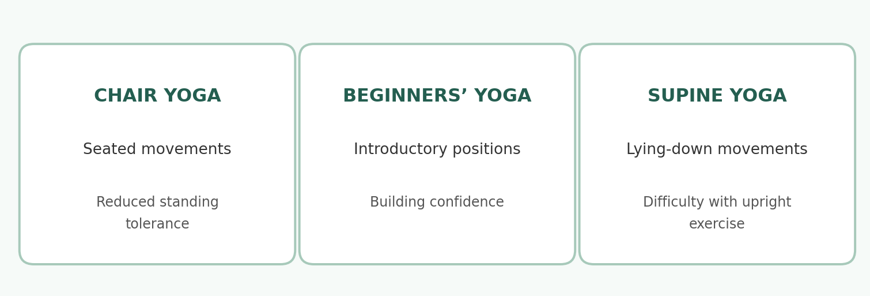
A visual comparison of the three accessible yoga options.
1. Chair Yoga for Beginners
Gentle movement without needing to stand or get onto the floor. Chair yoga adapts traditional yoga movements so they can be performed while seated. It may be particularly useful for older adults, people with reduced balance, individuals with limited mobility or those who find standing exercise difficult.
Chair yoga can incorporate gentle upper-body movements, supported posture work, breathing exercises and comfortable joint movement. It can also provide an approachable introduction to yoga for people who have never practised before.
Explore our Chair Yoga for Beginners playlist:
For additional NHS guidance, visit: https://www.nhs.uk/live-well/exercise/sitting-exercises
2. Beginners’ Yoga
Building confidence through gentle, foundational yoga movements. Starting yoga does not require previous experience, specialist flexibility or advanced physical fitness. Beginners’ yoga introduces basic positions, breathing techniques and controlled movements.
Depending on the individual and the exercises selected, it may support flexibility, strength, balance and relaxation. This playlist is designed for people who want to begin exploring yoga gradually and build confidence at their own pace. Use supports where needed, avoid painful positions and choose alternatives when a movement does not suit your body.
Explore our Beginners’ Yoga playlist:
3. Supine Yoga — Gentle Yoga While Lying Down
Supporting movement and relaxation from a lying-down position. Supine yoga involves practising yoga movements while lying on the back. It can provide an alternative for people who struggle with standing positions, balance demands or certain seated exercises.
Depending on individual needs, supine yoga may include gentle movements of the arms and legs, comfortable mobility exercises, breathing practices and relaxation. For some people, lying down reduces the effort needed to maintain an upright position, making selected movements more manageable.
However, supine yoga is not automatically suitable for everyone. People with breathing difficulties when lying flat, significant spinal conditions or other medical restrictions may require adaptations.
Explore our Supine Yoga playlist:
Yoga and Chronic Illness: Why Personalisation Matters
There is no single yoga routine that will suit everyone living with a chronic health condition. Someone managing arthritis may have different movement needs from someone living with fibromyalgia, neurological illness, hypermobility or severe fatigue.
Symptoms may also fluctuate from one day to another. On some days, a gentle beginner session may feel manageable. On others, a short seated breathing exercise may be more appropriate. Some people may need to avoid exercise during symptom flare-ups or seek specialist guidance before attempting new movements.
For conditions involving post-exertional malaise, such as some cases of ME/CFS or Long COVID, increasing activity can worsen symptoms. Pacing and condition-specific medical advice are essential. Accessible yoga should offer choices, not pressure.
It should never require someone to ignore pain, dizziness, breathlessness, unusual fatigue or other warning signs.
An Alternative for Hypermobility: Pilates & Gentle Movement
For people with joint hypermobility, hypermobility spectrum disorders or hypermobile Ehlers–Danlos syndrome, exercises that emphasise controlled strengthening and joint stability are often prioritised over deep stretching. Pilates may be a helpful alternative to some yoga practices because it can focus on core control, stability and body awareness, provided the exercises are appropriately adapted. It is not automatically suitable for everyone, so individual guidance from a physiotherapist is advisable, particularly when joints are unstable or painful. You can explore our Pilates & Gentle Movement playlist here:
Getting Started: Five Gentle Principles
- Start small. A short, comfortable session may be more appropriate than attempting a full routine.
- Choose the right position. Chair yoga, beginners’ yoga and supine yoga offer different ways to participate.
- Focus on control rather than depth. Comfortable movement matters more than stretching further.
- Allow time for recovery. Rest and pacing are important, especially when living with fluctuating symptoms.
- Listen to your body. Stop if an exercise causes pain, dizziness, unusual breathlessness or worsening symptoms, and seek medical advice when appropriate.
If you have a chronic health condition, recent surgery, significant balance problems or uncertainty about which exercises are suitable, speak with your GP or physiotherapist before starting.
Yoga as Part of Your Holistic Health Package
Holistic wellbeing recognises that physical health, emotional wellbeing, sleep, stress and daily habits are interconnected. Yoga can complement other supportive approaches, including meditation, relaxation, appropriate medical treatment, nutrition and restorative sleep.
For some people, yoga may become an enjoyable part of their morning routine… For others, a few minutes of chair yoga may offer an opportunity to move gently during the day.
And for those who prefer lying-down movement, supine yoga may provide an alternative worth exploring with appropriate guidance. There is no requirement to practise every day or complete every exercise.
The most valuable approach is one that feels safe, sustainable and suited to your circumstances.
Final Thoughts: Yoga Is About Progress, Not Perfection
Yoga should never be defined by how flexible someone is, how long they can hold a position or whether they can perform a particular movement. Its value lies in the opportunity to move with awareness, develop confidence and support physical and emotional wellbeing.
Whether you are beginning your yoga journey, managing a long-term health condition or looking for a gentler approach to movement, there are different ways to participate. Our three yoga playlists have been organised to make accessible options easier to find and incorporate into everyday life.
You do not have to move like everyone else to experience the benefits of movement. Start where you are, adapt where necessary and remember that gentle progress is still progress.
References and Further Reading
1. NHS. How to improve your strength and flexibility.
https://www.nhs.uk/live-well/exercise/how-to-improve-strength-flexibility
2. Department of Health and Social Care. UK Chief Medical Officers’ Physical Activity Guidelines.
3. Cochrane (2022). Yoga for chronic non-specific low back pain.
https://www.cochrane.org/evidence/CD010671_yoga-chronic-non-specific-low-back-pain
4. NHS. Sitting exercises.
https://www.nhs.uk/live-well/exercise/sitting-exercises
5. Department of Health and Social Care. Physical activity guidelines: disabled adults.
https://www.gov.uk/government/publications/physical-activity-guidelines-disabled-adults
6. NHS. Physical activity guidelines for adults aged 19 to 64.
https://www.nhs.uk/live-well/exercise/physical-activity-guidelines-for-adults-aged-19-to-64
Disclaimer: Please note, all advice given is based on various healthcare models that have been proven to support patients with sustainability and backed by Public Health England (PHE). Nonetheless, you should run any changes to your routine by your GP as they are your primary healthcare provider and first point of contact. It is also important that any other healthcare professionals involved in your care is involved in any goal planning. Don’t forget they hold your medical records and are familiar with your health needs: this will help everyone be on the same page and will also enable you to plan more realistically and not overestimate your capacity, which could negatively affect your health.