

Why restorative sleep is one of the most important pillars of living well with chronic illness.
Author: Berta Kaguako
Sleep Is Not a Luxury — It Is Health Essential!!!!
When living with a chronic illness, managing symptoms can feel like a full-time responsibility. Between medical appointments, medication, fatigue, pain and the emotional challenges of long-term health conditions, sleep can sometimes become another struggle.
Yet sleep is one of the most vital components of a holistic approach to health and wellbeing. Quality sleep supports physical restoration, emotional regulation, cognitive functioning and immune health. It also influences how we experience and manage symptoms associated with chronic illness.
Prioritising sleep is not simply about feeling less tired. It is about creating a stronger foundation for managing your health.
Why Sleep Is Restorative: What Happens While We Sleep
Sleep is not a passive shutdown. Throughout the night, the brain and body coordinate essential maintenance: processing memories, regulating hormones, supporting immune responses, maintaining metabolism and enabling tissue recovery. These processes benefit everyone, whether or not they live with a long-term health condition.
The Four Stages of Sleep
Sleep consists of three non-rapid-eye-movement (non-REM) stages and rapid-eye-movement (REM) sleep. Most adults move through approximately four to six cycles each night, often lasting around 80–100 minutes. Deep sleep tends to be more prominent earlier in the night, while REM periods become longer towards morning [6, 7].
The chart below gives an illustrative adult sleep-stage distribution. Actual proportions vary with age, health and individual nights; they are not targets to achieve.
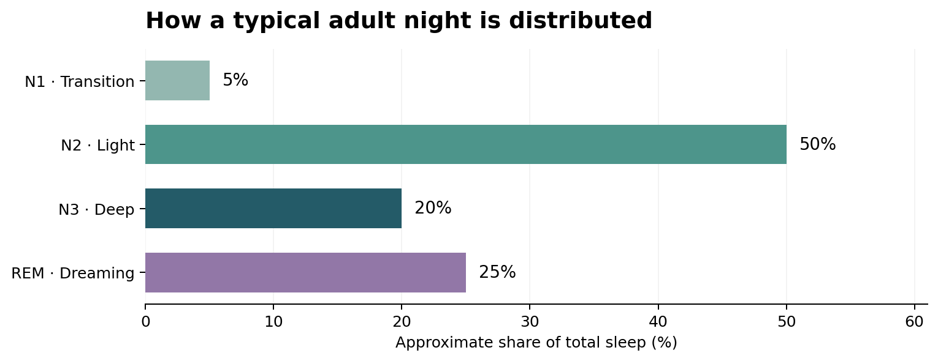
Figure 1. Illustrative proportions: N1 5%, N2 50%, N3 20%, REM 25%. Source: sleep-stage overview in NIH/NCBI clinical literature [10].
Stage N1: The Transition Into Sleep
N1 is the brief, light stage between being awake and asleep. Muscles relax, breathing and heart rate begin to slow, and people can be awakened easily. Although it is not the deepest restorative stage, it is the gateway that allows the body to settle into sustained sleep.
Stage N2: Light Sleep That Supports Learning
During N2, body temperature drops and heart rate slows further. The brain shows distinctive bursts of activity called sleep spindles and K-complexes, which are associated with processing information and protecting sleep from disruption. N2 usually makes up the largest share of adult sleep and contributes to memory and stable rest [6, 7].
Stage N3: Deep, Slow-Wave Sleep and Physical Recovery
N3 is the deepest non-REM stage. It is associated with restorative processes including growth-hormone release, tissue maintenance and repair, and aspects of immune regulation. Deep sleep also contributes to memory consolidation and feeling refreshed. The amount of N3 generally declines with age; this is a normal change and does not mean older adults cannot benefit from sleep [6–8].
REM Sleep: Emotional Processing and Brain Health
REM sleep features active brain patterns, rapid eye movements and temporary relaxation of most voluntary muscles. Vivid dreams commonly occur here. REM contributes to learning, memory integration and emotional processing. Both REM and non-REM sleep are necessary; neither stage is the single “most important” one [6, 7].
How These Stages Support Whole-Body Health
Across a full night, sleep supports the heart and blood vessels, helps regulate appetite and blood glucose, strengthens immune functioning, and maintains attention, decision-making and mood. Insufficient or fragmented sleep can interfere with these systems. This matters for school, work, relationships, physical activity and healthy ageing—not only for chronic illness management [7, 8].
The goal is therefore not to chase a particular percentage of deep or REM sleep on a wearable device. Consumer trackers only estimate stages. Consistent, sufficient, refreshing sleep and how you function during the day are more useful practical indicators.
Sleep by the numbers
• NHS guidance: most adults need around 7–9 hours of sleep each night, although individual needs vary [11].
• A typical night includes around 4–6 sleep cycles, often lasting 80–100 minutes each [6].
• A 2025 Mental Health Foundation survey of 2,000 UK adults found that 38% said poor sleep negatively affected their mental health at least once a week, and 14% said they never got the sleep they needed to function well in a typical week [12].
Why Sleep Matters When Living With Chronic Illness
Chronic illnesses such as fibromyalgia, arthritis and diabetes can make restorative sleep difficult. Pain, anxiety, medication side effects, physical discomfort and disrupted routines may interfere with natural sleeping patterns. The relationship between sleep and chronic illness can work in both directions: chronic pain can disrupt sleep, while insufficient sleep can increase pain sensitivity.
- Pain management: Sleep can influence pain sensitivity and how manageable symptoms feel.
- Emotional wellbeing: Restorative sleep supports mood and emotional regulation.
- Energy and daily functioning: More consistent sleep may make everyday activities easier to manage.
- Concentration and memory: Sleep supports cognitive functioning.
- Physical health: Sleep supports normal immune, metabolic and restorative processes.
Better sleep cannot cure chronic illness, but it can be an important part of supporting quality of life and symptom management.
Sleep as Part of Your Holistic Health Package
Holistic health recognises that physical, emotional and psychological wellbeing are interconnected. A comprehensive approach to chronic illness management may include appropriate medical treatment, nutrition, adapted movement, stress management, meditation, emotional support and restorative sleep.
Sleep deserves particular attention because poor sleep can affect several of these areas at once. The aim is not perfect sleep every night, but realistic habits that support your natural sleep patterns and respect your individual health needs.
What Is Sleep Training, and Can Adults Learn to Sleep Better?
Sleep training is often associated with babies. For adults, the more accurate term is sleep retraining, particularly through Cognitive Behavioural Therapy for Insomnia (CBT-I). This evidence-based treatment helps people change thoughts and behaviours that contribute to persistent insomnia. NHS Inform describes CBT-I as a first-line treatment for insomnia.
Five Ways to Begin Developing Healthier Sleep Habits
1. Establish a consistent sleep routine
Aim for a regular waking time and a manageable bedtime routine. Consistency helps reinforce your sleep-wake rhythm.
2. Create a calming bedtime environment
Reduce unnecessary noise, adjust lighting and temperature, and use positioning aids where needed.
3. Introduce a wind-down period
Choose calming activities such as gentle breathing, meditation or quiet music. Relaxation need not be forced into sleep.
4. Understand the connection between your bed and sleep
CBT-I includes stimulus-control techniques. If you are bed-bound, advice to leave bed when awake may be impractical and should be adapted with a clinician.
5. Address unhelpful thoughts about sleep
CBT-I can help reduce anxiety about not sleeping. More intensive methods that adjust time in bed should be professionally adapted where illness, fatigue or mobility limitations are present.
NHS Sleep Training and Support
For practical NHS guidance on sleep retraining and CBT-I, visit:
NHS Inform — Sleep Problems and Insomnia Self-Help Guide: https://www.nhsinform.scot/illnesses-and-conditions/mental-health/mental-health-self-help-guides/sleep-problems-and-insomnia-self-help-guide
NHS — Insomnia: https://www.nhs.uk/conditions/insomnia/
If sleep difficulties persist, affect your daily life or may be linked to a medical condition, speak to your GP.
Supporting Sleep Through Relaxation and Music Playlist
Alongside sleep routines and evidence-based care, music can help create a comforting bedtime atmosphere. It is a supportive wellbeing tool, not a substitute for treatment of persistent insomnia or an underlying sleep disorder.
Our Sleep & Relaxation YouTube playlist brings together four styles to suit different preferences:
- Lullabies — Gentle, comforting melodies for a reassuring bedtime atmosphere.
- Sleep Anxiety — Calming music for nighttime worries and racing thoughts.
- Hypnosis & Reassurance — Soothing, repetitive music and reassuring soundscapes to complement relaxation.
- Cinematic Fantasy Sleep Music — Dreamlike, atmospheric music for peaceful imagination.
Explore our Sleep & Relaxation YouTube playlist:
Watch the playlist: https://www.youtube.com/playlist?list=PLGC14gunkIMo
Small Changes Can Make a Meaningful Difference
Living with chronic illness may mean adapting routines around pain, fatigue, medication or mobility needs. Improving sleep is not about imposing rigid rules. It is about finding a flexible, personalised approach that fits your circumstances. Sleep retraining, relaxation and calming music may all play a role when used appropriately. Improving sleep should never become another source of pressure.
A Brief Look at Sleep and Longevity
Healthy sleep is also linked with longer-term health. A large observational study involving more than 60,000 UK Biobank participants found that more regular sleep-wake timing was associated with lower mortality risk over follow-up [9]. However, association does not establish that changing sleep patterns alone will extend life, and illness itself can affect sleep.
For healthy ageing, a balanced approach is sensible: aim for sufficient sleep, a reasonably consistent routine, daytime light and activity where possible, and assessment of persistent sleep problems. Sleep is one important part of longevity alongside medical care, nutrition, movement and social connection.
Final Thoughts
Sleep is a foundation of holistic wellbeing and deserves a central place in chronic illness management. Our holistic health playlists have been organised to make accessible wellbeing resources easier to find and incorporate into everyday life. Begin with our Sleep & Relaxation playlist, explore what feels comforting and remember that caring for your sleep is part of caring for your overall health.
References & Further Reading
1. NHS Every Mind Matters — Sleep problems https://www.nhs.uk/every-mind-matters/mental-health-issues/sleep/
2. NHS — 10 ways to reduce pain https://www.nhs.uk/live-well/pain/10-ways-to-ease-pain/
3. NHS Inform — Sleep problems and insomnia self-help guide https://www.nhsinform.scot/illnesses-and-conditions/mental-health/mental-health-self-help-guides/sleep-problems-and-insomnia-self-help-guide
4. NHS — Insomnia https://www.nhs.uk/conditions/insomnia/
5. Qaseem et al. (2016), Management of Chronic Insomnia Disorder in Adults, Annals of Internal Medicine https://doi.org/10.7326/M15-2175
6. National Heart, Lung, and Blood Institute (NIH). How Sleep Works: Sleep Phases and Stages. https://www.nhlbi.nih.gov/health/sleep/stages-of-sleep
7. National Institutes of Health. Healthy Sleep. https://health.nih.gov/health-topics-a-z/healthy-sleep
8. MedlinePlus. Healthy Sleep. https://medlineplus.gov/healthysleep.html
9. Windred DP, et al. (2024). Sleep regularity is a stronger predictor of mortality risk than sleep duration: A prospective cohort study. Sleep. https://doi.org/10.1093/sleep/zsad253
10. NCBI Bookshelf — EEG Normal Sleep: typical adult sleep-stage proportions. https://www.ncbi.nlm.nih.gov/books/NBK537023/
11. NHS Every Mind Matters — Sleep problems: most adults need around 7–9 hours. https://www.nhs.uk/every-mind-matters/mental-health-issues/sleep/
12. Mental Health Foundation (24 October 2025). Average adult has only 3 days a week with good quality sleep. UK survey of 2,000 adults. https://www.mentalhealth.org.uk/about-us/news/average-adult-has-only-3-days-week-good-quality-sleep
Disclaimer: Please note, all advice given is based on various healthcare models that have been proven to support patients with sustainability and backed by Public Health England (PHE). Nonetheless, you should run any changes to your routine by your GP as they are your primary healthcare provider and first point of contact. It is also important that any other healthcare professionals involved in your care is involved in any goal planning. Don’t forget they hold your medical records and are familiar with your health needs: this will help everyone be on the same page and will also enable you to plan more realistically and not overestimate your capacity, which could negatively affect your health.